
Organizations today are operating in a fundamentally different human environment than they were even a decade ago. For many of them, pressure is no longer episodic. It has become continuous.
Work has become faster, more connected, more complex, and more psychologically demanding. AI is accelerating expectations. Transformation initiatives rarely stop. Teams are navigating continuous uncertainty, increasing emotional load, and rising performance pressure while still being expected to remain collaborative, adaptable, innovative, and engaged.
This shift is changing the role of Human Resources itself. HR leaders are no longer being asked only to support hiring, engagement, compliance, and employee experience. Increasingly, they are being asked to help organizations
sustain human performance under pressure.
1.1A widening mandate.
HR leaders are now being asked to help organizations improve leadership effectiveness, manager capability, communication under stress, resilience and adaptability, trust and psychological safety, workforce sustainability, burnout prevention, collaboration during uncertainty, and organizational culture under pressure.
The challenge is no longer simply operational. It is increasingly human.
The organizations that will lead through the next decade will not be those with the best technology — they will be those that understand how human beings behave, communicate, collaborate, and perform under pressure.The Vasana Thesis · 2026
1.2The modern workforce environment.
Why pressure has become a continuous organizational condition.
The modern workforce environment has fundamentally changed. Employees today are navigating a level of sustained cognitive, emotional, and behavioral pressure that many organizations were not originally designed to support.
Transformation cycles are accelerating. AI is reshaping workflows and expectations. Communication volume continues to rise. At the same time, the boundaries between work, communication, and recovery have become increasingly blurred. Microsoft’s Work Trend Index describes the emergence of the infinite workday, where employees operate inside a near continuous stream of meetings, emails, alerts, notifications, chats, and interruptions.
- Urgency
- Focus
- Accountability
- Innovation
- Adaptability
- Execution momentum
- Chronic
- Unmanaged
- Culturally normalized
- Disconnected from recovery
- Structurally reinforced
Organizations often mistake sustained output for sustainable performance. They are not the same thing.
1.3The new HR mandate.
From traditional HR to organizational resilience and human performance.
Historically, HR functions were centered around hiring, compliance, administration, policies, compensation, and employee relations. Today, HR leaders are increasingly operating at the center of organizational resilience itself — being asked to help organizations navigate burnout, retention pressure, disengagement, leadership overload, manager effectiveness, organizational trust, psychological safety, change fatigue, communication breakdown, and workforce adaptability.
Human performance is becoming a business capability.
Organizations are beginning to recognize that burnout impacts execution quality, that emotional exhaustion impacts decision making, that trust impacts collaboration, that manager capability impacts engagement, that communication impacts resilience, and that recovery impacts long-term sustainability.
1.4The four dimensions of organizational pressure.
A framework for understanding pressure inside modern organizations.
Across industries, organizations today are increasingly navigating four interconnected dimensions of pressure simultaneously. Together, these pressures shape how organizations communicate, collaborate, make decisions, build trust, adapt, manage conflict, and sustain performance over time.
Operational pressure
The pressure created by growth, transformation, complexity, execution demands, and continuous organizational change.
Human pressure
The pressure carried by leaders, managers, teams, and employees as they sustain performance under prolonged cognitive and emotional load.
Cultural pressure
The pressure that emerges inside communication systems, trust dynamics, and organizational relationships during uncertainty.
Biological pressure
The instinctive survival responses that emerge under sustained stress — influencing behavior, leadership style, conflict, and decision making.
The pressure inside modern organizations.
Why modern organizations are experiencing rising human strain — and what that strain looks like on the ground.
2.1Burnout and sustained energy imbalance.
Why recovery is becoming a strategic performance requirement.
Burnout occurs when energy expenditure continuously exceeds recovery. Burnout is not simply exhaustion — it is performance deterioration. The World Health Organization classifies burnout as an occupational phenomenon associated with chronic workplace stress that has not been successfully managed.
Many organizations unintentionally normalize chronic overextension as commitment. Over time, this creates declining adaptability, reduced emotional regulation, and deteriorating collaboration.
- Emotional exhaustion
- Cynicism
- Irritability
- Declining motivation
- Cognitive fatigue
- Communication withdrawal
- Normalize sustainable pacing
- Reduce unrealistic workload expectations
- Create recovery-conscious leadership norms
- Monitor burnout indicators earlier
- Support healthier performance rhythms
2.2The manager pressure crisis.
Middle management has become the pressure transmission layer of modern organizations.
Managers have become one of the most pressured groups inside modern organizations. They sit directly between executive expectations and employee realities — absorbing pressure from leadership while simultaneously regulating pressure for teams.
Modern managers are expected to drive performance, maintain engagement, support employee wellbeing, communicate organizational change, coach employees, navigate conflict, and sustain execution under uncertainty. Many are overloaded themselves. Gallup workplace research increasingly points to declining manager engagement as one of the major contributors to broader organizational disengagement.
When managers become depleted, communication deteriorates, psychological safety weakens, and trust declines — fast.Pressure inside modern organizations
2.3Change fatigue and workforce adaptability.
Continuous transformation without stabilization creates fatigue.
Organizations are now operating through nearly continuous transformation — AI adoption, restructuring, modernization, workforce redesign, system migrations, operational change. Transformation itself is not the problem. Continuous transformation without stabilization creates fatigue.
Employees gradually lose cognitive and emotional capacity when uncertainty becomes constant. This appears as disengagement, withdrawal, reduced trust, lower adaptability, skepticism, and emotional exhaustion. Organizations often underestimate the emotional cost of continuous change.
Reduce uncertainty by holding the narrative steady through the change.
People absorb change when they understand the reason it is happening.
Sequence change so teams can metabolize one wave before the next.
2.4Communication breakdown under pressure.
Many organizational conflicts are not capability problems. They are pressure collisions.
Pressure dramatically changes communication. Under stress, empathy narrows, defensiveness increases, patience declines, trust weakens, and communication becomes more reactive. Teams begin operating from survival patterns rather than collaboration — creating misunderstandings, emotional escalation, reduced psychological safety, organizational friction, and slower alignment.
2.5Psychological safety under stress.
Under pressure, silence is frequently self-protection.
Psychological safety deteriorates under prolonged pressure. As uncertainty and overload increase, employees often become more cautious about speaking openly, challenging ideas, admitting mistakes, asking for support, or expressing disagreement. Fear gradually replaces openness.
When psychological safety weakens, innovation declines, communication narrows, collaboration deteriorates, and learning slows. Organizations often misinterpret silence as alignment.
2.6Retention, engagement & emotional exhaustion.
Human sustainability is becoming a competitive advantage.
Retention challenges are often symptoms of deeper organizational strain. Employees increasingly leave organizations not only because of compensation or opportunity, but because of emotional exhaustion, poor leadership experiences, lack of support, communication breakdown, unsustainable pressure, and declining trust.
Engagement itself becomes difficult to sustain when employees operate in survival mode for prolonged periods. Organizations that sustain healthy engagement over time typically build cultures that support trust, adaptability, emotional awareness, communication, recovery, and leadership consistency.
The biology of behavior under pressure.
Pressure does not create character. Pressure reveals biology.
3.1Why stress changes behavior.
When uncertainty, overload, instability, or perceived threat increase, the nervous system gradually shifts into survival mode. Stress chemistry rises. Emotional reactivity increases. Cognitive flexibility narrows. Access to higher-order thinking becomes less consistent.
Modern organizations often assume people will continue operating rationally regardless of environmental intensity. Behavioral science and neuroscience suggest otherwise.
3.2Why stress changes behavior.
Under sustained pressure, the brain prioritizes protection and certainty. This reduces creativity, empathy, adaptability, strategic thinking, and emotional flexibility. People become more reactive and less reflective. Communication becomes faster, narrower, and more emotionally charged.
The body has four ancient responses to pressure. They are not character flaws — they are biology.
Fight
Increased urgency. Controlling behavior. Communication becomes directive and emotionally charged.
Flight
Scattered focus. Avoidance of difficult conversations. Emotional escalation.
Freeze
Overthinking. Analysis paralysis. Delay of decision in service of certainty.
Fawn
Emotional suppression. Over-accommodation. Resentment buildup beneath the surface.
3.3Pressure and organizational behavior.
Organizations often define culture aspirationally. Real culture is revealed under pressure. Under sustained stress, organizations frequently become more reactive, more emotionally narrow, more defensive, and less collaborative. Pressure exposes the underlying emotional and behavioral systems inside organizations.
3.4Pressure collisions inside teams.
Many workplace conflicts are not capability problems. They are biological survival pattern collisions under pressure.
Without awareness, these collisions gradually create defensiveness, communication breakdown, mistrust, and organizational friction.
3.5Pressure signals HR leaders should watch for.
Early indicators of organizational strain — most appear long before significant deterioration occurs.
Organizations that identify these patterns early are better able to intervene before burnout, disengagement, or cultural deterioration accelerates.
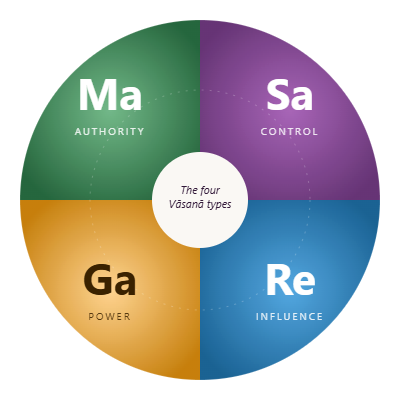
The Vāsanā framework.
Four common biological patterns that emerge under pressure. Each capable of brilliance. Each with its own collisions.
Pressure does not create
character.
It reveals biology.
Across decades of behavioral observation, four core survival patterns emerge under pressure. Each is capable of brilliance. Each carries its own collisions. Naming them is the first step toward working with them.
Moves toward pressure through control, decisiveness, and speed.
Common pressure behaviors
- Impatience
- Controlling communication
- Emotional intensity
- Premature decision compression
Growth comes through
- Empathy
- Curiosity
- Emotional awareness
Responds to pressure through movement, flexibility, and emotional expression.
Common pressure behaviors
- Scattered thinking
- Emotional escalation
- Overcommitting
- Inconsistency under stress
Growth comes through
- Steadiness
- Structure
- Operational discipline
Responds to pressure by preserving harmony, stability, and connection.
Common pressure behaviors
- Emotional suppression
- Over-accommodation
- Silent overworking
- Resentment buildup
Growth comes through
- Boundaries
- Prioritization
- Objective communication
Responds to pressure through caution, precision, analysis, and risk reduction.
Common pressure behaviors
- Overthinking
- Perfectionism
- Delayed decisions
- Analysis paralysis
Growth comes through
- Decisiveness
- Action
- Adaptability
4.6Pressure collisions inside organizations.
Many organizational conflicts are not capability problems. They are survival pattern collisions under pressure.
Without awareness, these pressure patterns create communication breakdowns, operational friction, reduced trust, and emotional defensiveness.
4.7The core Vāsanā principle.
Pressure does not create character. Pressure reveals biological survival patterns.The Vāsanā principle
The goal of the Vāsanā framework is not to eliminate pressure. The goal is to improve self-awareness, reduce relational friction, restore adaptability faster, strengthen communication, and sustain healthier performance.
Building organizations excellent under pressure.
The highest-performing organizations are not pressure-free. They become pressure-adaptive.
5.1—5.3Leaders, managers, teams.
Three layers of the same capability. None work without the other two.
Organizations increasingly need leaders who can:
- Regulate themselves under stress
- Communicate clearly during uncertainty
- Maintain trust under pressure
- Sustain adaptability during change
Managers shape:
- Engagement
- Communication
- Team trust
- Collaboration
- Emotional culture
Healthy teams require:
- Psychological safety
- Communication clarity
- Emotional regulation
- Pressure awareness
5.4—5.6Recovery, communication, culture.
Recovery-conscious cultures. Sustainable performance requires sustainable recovery. Organizations increasingly need cultures that normalize recovery, boundaries, sustainable pacing, and healthier performance rhythms.
Pressure-aware communication systems. Communication systems must support clarity during uncertainty. Organizations should intentionally strengthen feedback culture, emotional awareness, conflict navigation, and communication adaptability.
Pressure-adaptive cultures. Most organizations define culture aspirationally. Pressure reveals culture operationally. The true nature of organizational culture becomes visible during periods of uncertainty, overload, transformation, conflict, and sustained pressure.
5.7Practical HR applications.
Leadership development
Helping leaders understand how they behave under pressure and how their communication impacts others.
Manager coaching
Helping managers regulate emotional responses and sustain healthier team environments.
Burnout prevention
Recognizing pressure patterns earlier — before emotional exhaustion accelerates.
Change management
Helping leaders and teams adapt more effectively during periods of transformation.
Conflict resolution
Understanding how different survival patterns create interpersonal tension.
Team effectiveness
Improving collaboration between different communication and pressure styles.
Psychological safety
Helping leaders create environments where employees feel safe contributing under pressure.
Organizational transformation
Supporting healthier communication, adaptability, and resilience during large-scale change.
5.8Practical organizational scenarios.
How human pressure commonly appears inside modern organizations.
The burned-out manager.
What HR leaders see
A previously high-performing manager becomes reactive, emotionally narrow, impatient, and withdrawn after prolonged overload. Team morale begins declining.
Beneath the surface
The manager has likely been operating in sustained survival mode for an extended period. Continuous load reduces emotional regulation, empathy, and recovery capacity.
Practical response
- Reduce unnecessary operational friction
- Rebalance unrealistic spans of control
- Provide leadership coaching
- Normalize sustainable pacing
- Create structured leadership support
Transformation resistance.
What HR leaders see
Employees appear resistant, disengaged, skeptical, or emotionally withdrawn during organizational transformation initiatives.
Beneath the surface
Employees are often experiencing accumulated change fatigue rather than resisting change itself. When uncertainty becomes continuous, the nervous system prioritizes stability and protection.
Practical response
- Communicate the purpose behind change
- Reduce unnecessary uncertainty
- Create stabilization periods
- Support managers with communication tools
- Acknowledge emotional fatigue honestly
The silent team.
What HR leaders see
A team stops openly challenging ideas, asking questions, or engaging in healthy disagreement. Meetings become quieter. Innovation slows.
Beneath the surface
Psychological safety has likely deteriorated under pressure. Employees may no longer feel emotionally safe taking interpersonal risks.
Practical response
- Train leaders to regulate emotional reactions
- Reward healthy dialogue and disagreement
- Create safer feedback environments
- Improve leadership self-awareness
- Normalize reflection after high-pressure periods
High-performer burnout.
What HR leaders see
A highly dependable employee quietly absorbs increasing pressure over time before suddenly disengaging or leaving the organization.
Beneath the surface
High performers often become organizational pressure absorbers. They overextend silently, internalize responsibility, and maintain output after recovery capacity is depleted.
Practical response
- Proactively monitor overload patterns
- Normalize asking for support
- Reduce dependence on chronic overperformers
- Encourage healthier boundaries
- Reward sustainable performance
Leadership pressure collision.
What HR leaders see
Two highly capable leaders repeatedly experience communication friction during high-pressure initiatives. One pushes for speed; the other for caution.
Beneath the surface
This is often a biological pressure collision rather than a competency issue. Different Vāsanā survival patterns respond differently under stress.
Practical response
- Improve pressure awareness across leadership
- Teach how different patterns communicate
- Create shared language around pressure
- Normalize constructive tension
- Focus on complementary strengths
A final perspective.
Pressure is now a permanent feature of the modern operating environment.
The future of HR will not be defined only by hiring, engagement surveys, policies, or talent management. It will increasingly be defined by an organization’s ability to sustain healthy human performance under continuous pressure.
The organizations that lead through this environment will be the organizations that:
- Understand human behavior deeply
- Build pressure-adaptive cultures
- Strengthen manager capability
- Improve communication under stress
- Support recovery and resilience
- Intentionally invest in sustainable human performance